OCA Telkomsel Clustering
Developed a comprehensive customer segmentation analysis for OCA Indonesia (Telkom's CPaaS arm), utilizing advanced clustering techniques to analyze multi-channel communication data across WhatsApp, SMS, Email, and Voice Calls. The project aimed to optimize revenue distribution, reduce business risk, and provide actionable insights for strategic decision-making through data-driven customer portfolio management.
Client:
RevoU x OCA x Telkomsel Indonesia
Date:
August 14, 2025
Type:
Customer Segmentation
Role:
Data Analyst
About
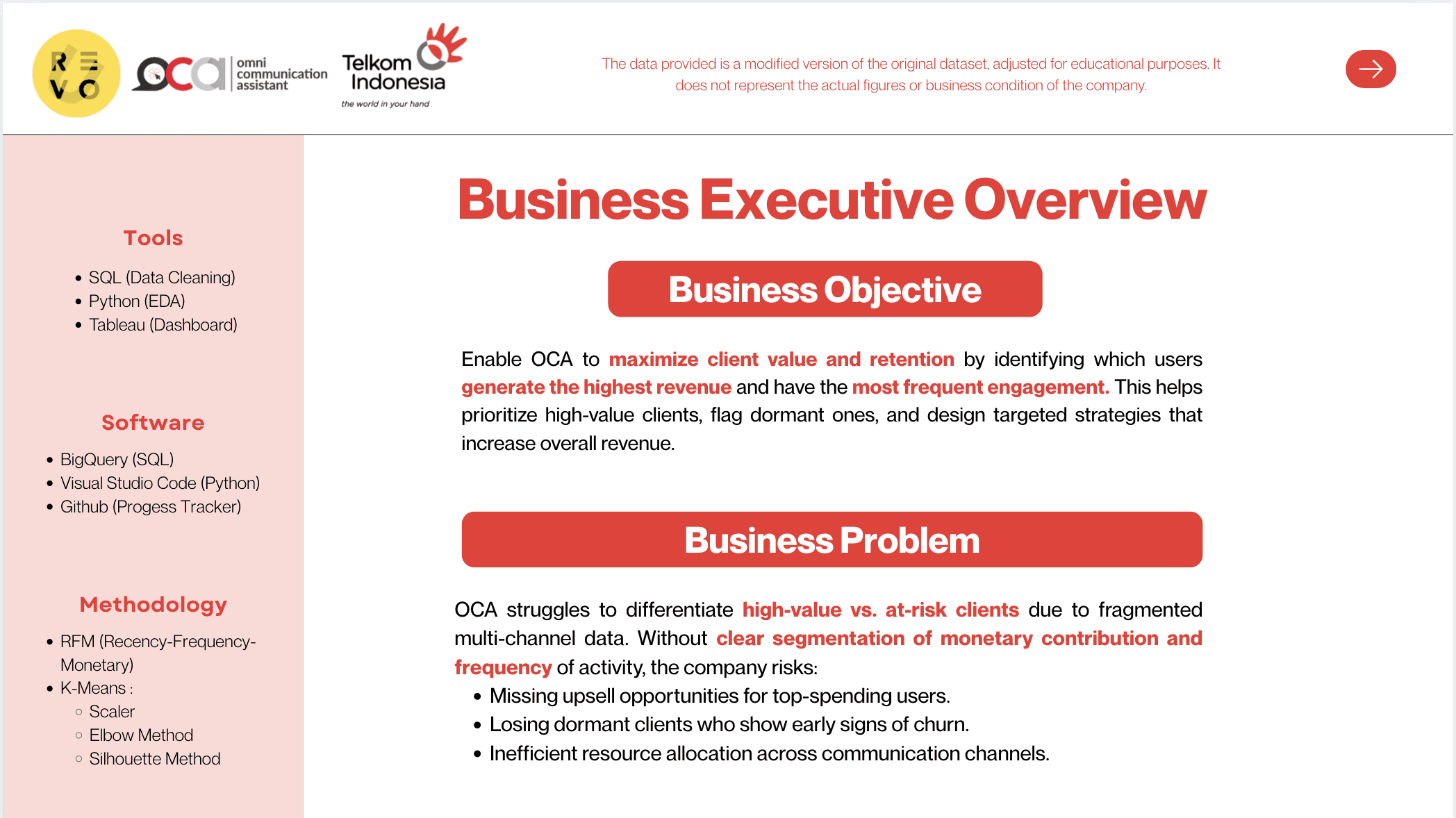
This project was part of my virtual internship at RevoU x Telkom Indonesia, where I conducted an end-to-end data analysis project for OCA (Omni Communication Assistant). The goal was to apply RFM methodology (Frequency-Monetary) and K-Means clustering to segment clients, uncover user behavior patterns, and provide strategic recommendations that reduce revenue concentration risk and ensure sustainable growth.
I handled the complete data pipeline from
SQL-based cleaning and preprocessing,
Python-based exploratory data analysis and clustering modeling
Tableau dashboard development for visualization and storytelling.
The outcome included actionable insights and strategic frameworks to address OCA’s revenue dependency on a small subset of clients.
Project Focuses
Analyzing 122,749 transactions across 20 B2B clients to segment users based on frequency and monetary value.
Applying K-Means clustering with Elbow & Silhouette methods to determine the optimal segmentation.
Building an interactive Tableau dashboard to track KPIs such as ARPU, AOV, Delivery Rate, Failure Rate, and Revenue Trends across clusters.
Designing a three-pillar strategy (Revenue Diversification, Value-Based Pricing, and Segment Graduation) to reduce dependency on top clients and optimize engagement across all segments.
Problem Statement
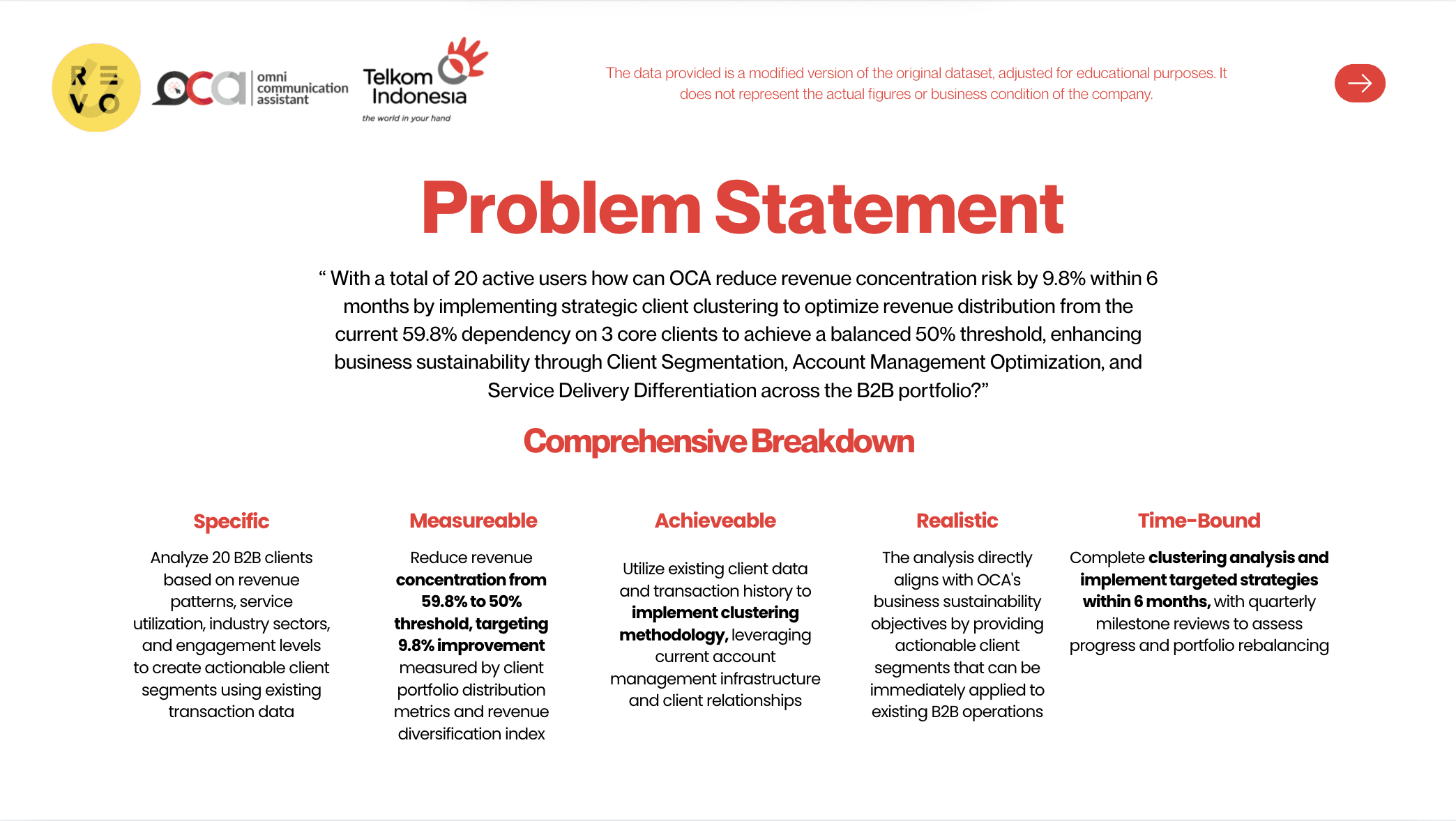
What factors are preventing OCA from achieving revenue sustainability and client retention, and how can clustering-based segmentation reduce dependency on only 15% of clients generating 59.8% of revenue, while driving balanced growth across all customer tiers?
Key Deliverables
Cluster Segmentation – 3 distinct client groups based on transaction frequency and monetary contribution.
Tableau Dashboard – real-time insights on transactions, revenue distribution, ARPU, AOV, delivery & failure rates.
Revenue Diversification Strategy – reduce concentration risk from 59.8% → <45%.
Value-Based Pricing Model – implement differentiated pricing for high-value vs. low-value clients.
Segment Graduation Framework – transition 20% of low-value clients to higher-value clusters.
Essential Link
Context
OCA (Omni Communication Assistant), a B2B communication platform by Telkom Indonesia, manages multi-channel client messaging across WhatsApp, SMS, Email, and Calls. Despite generating strong revenues (~Rp. 27.6M/month), the company faced risks due to:
High dependency on 3 clients, contributing nearly 60% of total revenue.
Uniform pricing (AOV ~Rp. 225) across all clients, failing to capture differentiated value.
Flat engagement strategies, with no tailored approaches for high, medium, and low-value clients.
This environment demanded a data-driven segmentation strategy to rebalance revenue streams, reduce risk, and sustain growth.
Business Environment
B2B Communication Market : competitive, with pricing and service quality as key differentiators.
Channel Diversification : clients use WhatsApp, SMS, Email, and Calls with varying transaction patterns.
External Risks : churn from high-value clients, limited scalability without optimized account management, and potential competitive loss without differentiated engagement.
Problem
With a total of 20 active users how can OCA reduce revenue concentration risk by 9.8% within 6 months by implementing strategic client clustering to optimize revenue distribution from the current 59.8% dependency on 3 core clients to achieve a balanced 50% threshold, enhancing business sustainability through Client Segmentation, Account Management Optimization, and Service Delivery Differentiation across the B2B portfolio?
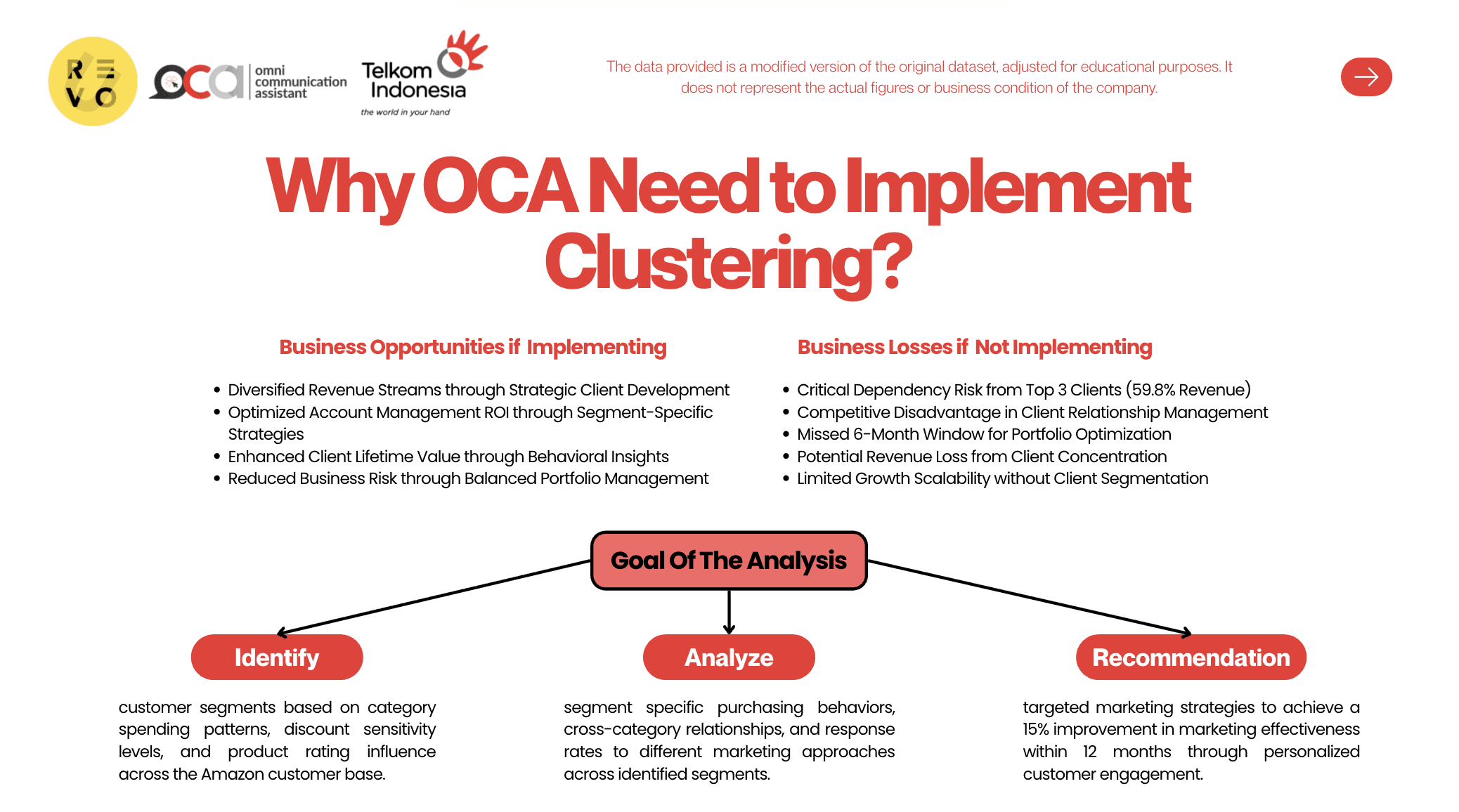
Revenue Concentration – Top 3 clients (15%) generating 59.8% of revenue.
Flat Pricing – No differentiation across segments despite different usage and value.
Operational Uniformity – Delivery and failure rates treated equally across segments (~85% delivery, ~15% failure).
Growth Ceiling – No graduation path for low-value clients to move upward in contribution.
Business Impact
Dependency Risk – losing a top client could result in a 20% immediate revenue drop.
Revenue Volatility – large monthly swings (–14.83% in February, +6.29% recovery in March).
Inefficiency – uniform pricing leads to lost revenue opportunities.
Scalability Risk – inability to expand client portfolio sustainably.
Objective
Deliver a clustering-based segmentation framework to:
Reduce revenue concentration from 59.8% to <45% within 6 months.
Increase overall monthly revenue from Rp. 27.6M → Rp. 40M (+45%).
Implement value-based pricing to raise AOV in Cluster 1 by +20%.
Graduate 20% of Cluster 3 clients to Cluster 2, adding +Rp. 2.49M revenue.
Process and Considerations
Step 1
Data Cleaning and Unified Data
Identified and decided to do the unified data among the dataset so it could matched the parameter of analysis and ease the exploratory data analysis while also the data visualization process in tableau, specific in each table or dataset. This cleaning and identifying process are done using SQL in BigQuery
Before |
|---|
Call - Table |
Email - Table |
SMS - Table |
Users - Table |
Whatsapp - Table |
After Transformation (Unified) | Dictionary |
|---|---|
Transactions | key transactions of each user |
User ID | key values of each user |
total_price | total price charge * message |
Charge | boolean between charge |
message_status | message condition between each channel |
channel_type | channel type ( Call, Email, SMS, Whatsapp ) |